Cada archivo que tocas aquí se queda en tu máquina.
Herramientas PDF, de imagen, para desarrolladores, SEO, de texto, para estudiantes y empresas — todas gratis, todas enteramente en tu navegador. Sin subidas, sin cuenta, ningún servidor ve tus datos.
Popular tools
The highest-demand tools with full options — browse by category below for the rest.
How this actually works
Each tool runs entirely with JavaScript already loaded in this page — PDF tools via pdf-lib and pdf.js, image tools via the browser's native Canvas API, and everything else with plain JavaScript. Your files or input are read into browser memory, processed, and handed back as a download or copyable result. This page itself is served by a small Laravel route; Laravel never sees your files either. The only backend in use is Supabase, and only for two optional things: signing in with a magic link, and — only if you're signed in — a log of which tool you ran and when. Honest limits worth knowing: Compress PDF flattens each page to a re-encoded image (great for scans, not ideal if you need selectable text after); HEIC conversion depends on your browser (Safari usually works; Chrome often cannot decode HEIC without a library we don't ship); Fill PDF Form is best-effort for simple AcroForm fields, not a full Adobe Forms replacement; and Word/Excel/PowerPoint ⇄ PDF genuinely needs a server-side engine, so it isn't included — this build only ships tools that can honestly run client-side.
Questions people actually ask
Can I mix JPG and PNG files in one PDF?
Yes — add any combination and they'll combine into one PDF, one image per page.
Can I reorder the images before converting?
Yes — drag them into the order you want on the options screen before running the tool; that order becomes the page order in the finished PDF.
How is each page sized?
Each page is sized to match its image's own proportions, capped at a sensible maximum width, so a portrait photo produces a portrait page and a wide screenshot produces a wide page.
What happens if one of my files is corrupted or not really an image?
It's skipped automatically, and the final status message lists which file names were skipped, so the rest of the batch still converts successfully.
How many images can I add at once?
There's no fixed limit beyond your device's memory — add as many as you need in one pass.
Does this crop, rotate, or straighten my images?
No — images are placed exactly as they are. If you're photographing a physical document and need cropping, rotation, or a scan-style cleanup, use Scan to PDF instead.
Can I reorder pages after the PDF is created?
Not in this tool — reorder the images in the upload list before running it, since that order becomes final in the output. To reorder an already-made PDF, use Organize PDF.
Is the quality reduced?
Only if an image exceeds the maximum page width, in which case it's scaled down proportionally; smaller images are embedded at their original resolution.
Is this really free, and is there a file size limit?
Yes — no account, no paywall. Since processing happens in your browser's memory rather than uploading anywhere, the practical limit is your device's available RAM, not a server quota. Very large files (500+ pages) may run slower, especially for Compress and PDF→JPG.
Does anything about my file get sent anywhere?
No. Every tool runs with pdf-lib/pdf.js loaded in this page; your file is read into browser memory and never leaves it. The only network call this app makes for your account is Supabase auth — and that only stores which tool you ran and when, never file content.
Why isn't Word/Excel/PowerPoint → PDF included?
Converting Office formats accurately needs a real rendering engine (what Word or LibreOffice use internally) — no browser library does this reliably. Rather than ship a broken version, it's left out.
Does TechDriven Tools have OCR (text recognition)?
Yes — OCR PDF recognizes text in scanned or photographed pages using Tesseract.js, running entirely on your device, and gives you a searchable PDF or a plain text file. Nothing is uploaded for this either.
Can I use this without an internet connection?
Once the page and its libraries have loaded once, yes — the tools themselves need no network access. Signing in and viewing history do require a connection, since those talk to Supabase.
What happens to the "history" if I sign in?
Only a row per tool run — the tool's name and a timestamp. No filename, no file content, ever. You can see the full list any time via the History button.
Are the non-PDF utilities (password generator, JSON formatter, etc.) private too?
Yes — same rule as the PDF tools. Word Counter, Case Converter, Password Generator, UUID Generator, Base64, Hash Generator, JSON Formatter and JWT Decoder all run with plain JavaScript already loaded in this page; nothing you type or paste is sent anywhere.
JPG/PNG to PDF, in depth
A folder of receipt photos, screenshots, or phone scans is hard to email as twenty attachments. JPG/PNG to PDF builds one ordered multi-page document — each image on its own page — entirely in your browser.
How JPG/PNG to PDF works here
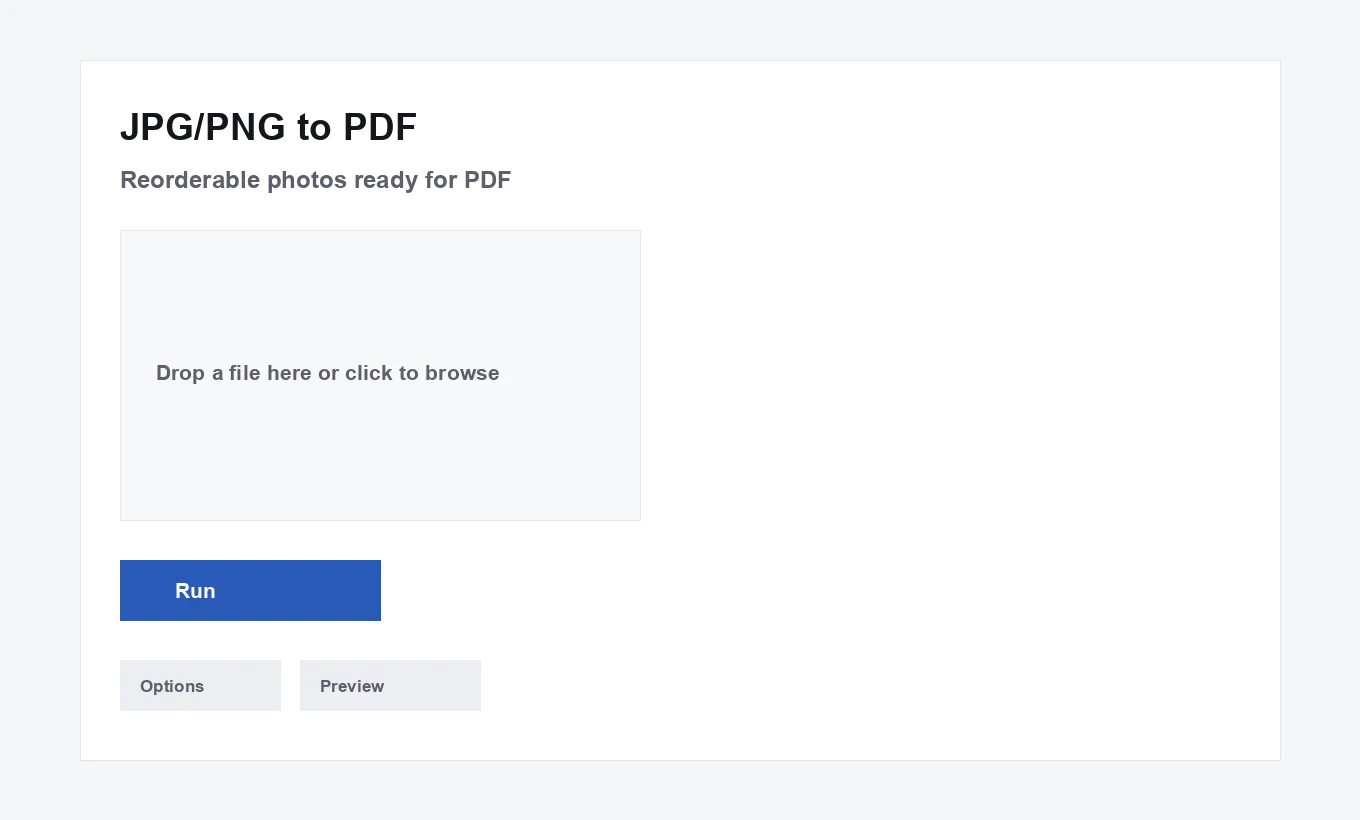
Add JPG or PNG files, drag them into reading order, and download images.pdf. Pages size to each image’s proportions (with a sensible max width). Corrupt non-images are skipped with names listed in status.
Key options: Reorderable image list; mix JPG and PNG; per-image page sizing capped around 1200pt width.. Change one at a time when comparing.
When to use it
Use img2pdf when the job matches what the tool is named for — not as a generic substitute for unrelated PDF or data tasks.
Prefer this browser version when the input is sensitive and you want processing to stay on-device with clear option names like: Reorderable image list; mix JPG and PNG; per-image page sizing capped around 1200pt width..
If the next step differs (for example you finished and now need a sibling utility), jump to a related tool instead of forcing one screen to do everything.
Prefer img2pdf in privacy-sensitive workflows where upload compressors are unacceptable.
Document team defaults so results stay consistent across people.
On mobile, watch memory with large inputs; split work if the tab struggles.
Expense receipt packs. Photograph receipts through the week, reorder chronologically, and submit one PDF to finance.
Bug-report screenshot bundles. Stack UI screenshots into a single PDF reviewers can page through in order.
Application photo packets. Portals that want ‘one PDF of supporting images’ get a clean convert instead of a ZIP of loose files.
Options that change the result
Primary controls
The important controls are: Reorderable image list; mix JPG and PNG; per-image page sizing capped around 1200pt width.. Change one at a time when comparing outcomes so you know what improved the result.
Run and verify
After you run img2pdf, open or inspect the output on the device where you will share it. Keep originals until that check passes.
Boundaries
This page does not replace desktop suites for heavy Office conversion or certified legal e-sign. It covers the focused job described above.
Defaults
Start moderate, then iterate one control at a time.
Surprises
Page scale and format choices drive most quality/size outcomes.
Naming
Rename zip/page outputs immediately after download.
Sharing
Verify the exact page or image before sending externally.
Privacy
img2pdf is designed to run in your browser so your files and text are not uploaded for the core transformation.
Still handle downloads carefully: a private process can still leave sensitive files in your Downloads folder.
Local processing means your PDFs/images are not uploaded for the conversion itself.
Manage Downloads copies under your retention policy.
Processing stays in your browser — ideal for confidential pages and photos.
Common mistakes
- Using this for crooked paper photos — It does not crop or deskew. Use Scan to PDF when you need cleanup.
- Ignoring EXIF sideways phone photos — Rotate the image or fix the PDF page with Rotate PDF afterward.
- Screenshotting a PDF to ‘convert’ it — Merge the real PDF instead of photographing it into images first.
Page sizing behavior
Portrait photos become portrait pages; wide screenshots become wide pages. Mixed aspect ratios in one PDF are normal on screen but can surprise printers — scale-to-fit when printing mixed sizes.
If you need a fixed Letter/A4 frame with margins, a word processor may fit better; this tool prioritizes image-true pages.
Related tools
These related tools commonly sit before or after img2pdf in real workflows.
- Merge PDF — Combine several PDFs into one, in the order you choose.
- PDF to JPG — Export every page as a high-res image.
- Rotate PDF — Rotate every page 90°, 180° or 270°.
JPG/PNG to PDF is the private way to turn an ordered image stack into one attachment. Set order first, skip scan-cleanup expectations, and verify orientation before you send.
Start from JPG/PNG to PDF.
Bookmark the live tool after reading option pitfalls.
Debug with a one-page sample before large batches.
Write option recipes for teammates instead of only screenshots.
For JPG/PNG to PDF, bookmark /jpg-to-pdf after you learn the option names in this guide — the article teaches; the tool page is for daily use.
If JPG/PNG to PDF output looks wrong, reproduce with a tiny sample first. Smaller fixtures debug faster than a production-sized input.
Name downloads from JPG/PNG to PDF with date + purpose the moment they arrive so you do not forward yesterday’s draft by mistake.
JPG/PNG to PDF sits in the Convert group on TechDriven Tools. If the next step differs, switch tools instead of stretching JPG/PNG to PDF past what it owns.
From our blog: How to Convert JPG or PNG Images to a PDF